
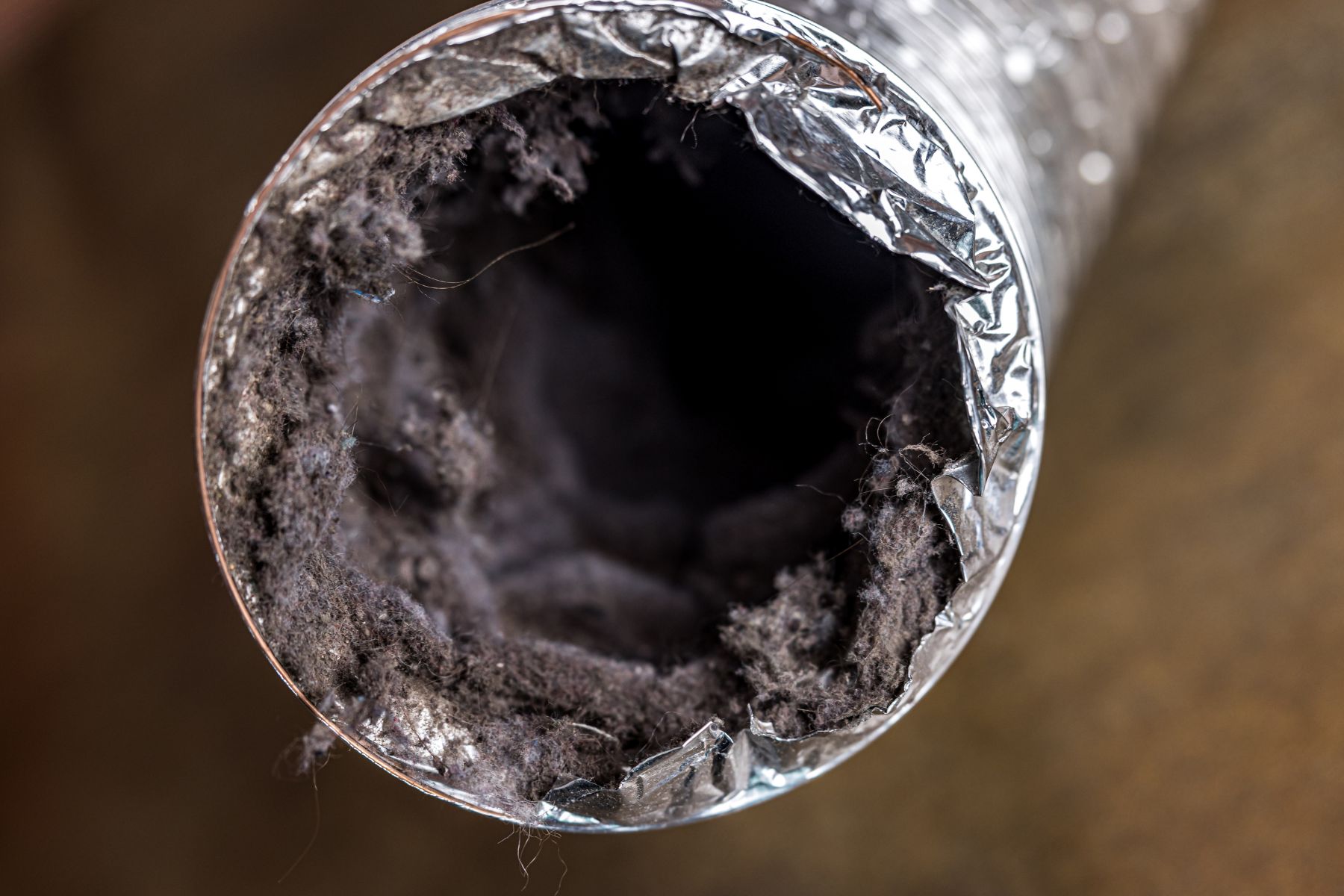
That sour, musty, wet-laundry smell that hits you for a couple of minutes when the system kicks on has a name. HVAC techs have called it dirty sock syndrome for about thirty years. It is mold and bacteria growing on your indoor coil, and the smell is those microbes getting warmed up and cooked off into your air.
Here is what almost every article about it gets wrong: they will tell you it is a spring air-conditioning problem. If you are smelling it in October or January, that advice will send you looking in the wrong place.
Dirty sock syndrome is primarily a heat pump problem, it is worst during the mode-flipping weather of fall and spring, and it started as a Southeast problem specifically. If you own a heat pump in North Alabama, you are close to the middle of the bullseye.
What Dirty Sock Syndrome Actually Is
Your indoor coil — the evaporator coil, sitting in the air handler — spends a lot of its life wet. In cooling mode it is pulling humidity out of your air by design, and that condensation runs down the coil into a drain pan.
Now add what is floating in household air: skin cells, pet dander, cooking grease, dust, pollen. That organic material sticks to a wet aluminum surface and stays there. Wet surface plus food equals a place where mold and bacteria are happy to live.
The microbes themselves are not what you smell. What you smell is what happens when warm air moves across a colony of them. They give off volatile organic compounds, and the particular mix that grows on coils happens to smell almost exactly like a gym bag left in a car. That is why the odor is strongest in the first few minutes after the system starts and then fades: you are smelling the initial flush, and once the coil has dried out or the colony has been blown clear for the cycle, it backs off.
Which is also why the problem reads as intermittent and easy to dismiss. It is not intermittent. It is a colony that is there all the time, announcing itself only when conditions are right.
Why It's Worse in Fall and Winter (and Why Everyone Tells You Otherwise)
Search the term and you will find page after page describing dirty sock syndrome as something you notice when you switch the AC on for the first warm day of spring.
That is half the story at best. Nationally, searches for dirty sock syndrome run around 1,600 a month through late summer, climb through November, and peak in December at roughly 4,400 — nearly triple the summer figure. People are overwhelmingly noticing this in cold weather. The articles are answering a season the readers are not in.
The reason is that this was always more of a heat pump problem than an air conditioner problem, and a heat pump's busy season is winter.
ACHR News, the HVAC industry's trade journal, laid out the mechanism: heat pumps are especially prone to it because "unlike conventional heat exchangers, their heating cycles were not hot enough to kill the microbes that thrived on their wet coils." A gas furnace runs its heat exchanger blisteringly hot. That heat sterilizes. A heat pump in heating mode warms the indoor coil to something more like bathwater — warm enough to cook the odor off the colony, not nearly warm enough to kill it.
So a furnace tends to burn the problem away. A heat pump gently simmers it and distributes the results through your house.
The Defrost Cycle Is the Real Culprit
There is a second mechanism, and it is the one that explains why this gets worse as it gets colder.
When frost builds up on the outdoor coil, your heat pump briefly reverses itself to melt it off. For those few minutes the system is effectively running in cooling mode — which means your indoor coil is doing what it does in summer and getting wet again. As ACHR News put it, that process "generated moisture on the indoor coil, giving dormant microorganisms and residual organic matter new life."
Every defrost cycle is a fresh drink of water for the colony you were hoping would dry out and die over the winter. The colder and damper the weather, the more defrost cycles you get, and the more often that coil gets re-wetted. (If you want the full explanation of what defrost cycles are and how they interact with your backup heat, we wrote about that in our post on auxiliary heat versus emergency heat.)
Why Cullman's October Is Almost Designed to Cause This
The trade coverage is specific about when this peaks: "during 'shoulder' seasons like fall and spring, when the units would be used for heating at night and cooling during the day."
Read that again and then look at a Cullman October. Our average high is 73°F. Our average low is 51°F. That is a 22-degree swing inside a single day.
What does a thermostat do with that? It calls for a little heat in the morning, sits idle through the middle of the day, and quite possibly calls for cooling by mid-afternoon if the house has soaked up sun. Then heat again overnight. The coil goes warm, then wet, then warm, then wet — over and over, for weeks.
That cycle is the single best set of conditions for growing coil microbes that exists, and North Alabama produces it twice a year, reliably, in October and again in April. September adds its own contribution: we average 13 muggy days, so the coil goes into fall already loaded with moisture and organic material.
It is worth knowing that the phenomenon was first widely reported, in ACHR's telling, "particularly in the Southeast." That is not a coincidence. Humid summers, mild winters, and near-universal heat pump adoption is the exact recipe, and it describes Cullman County precisely.
Is It Dangerous?
Here is the measured answer, because this question deserves one rather than a sales pitch.
The smell itself is not a poison, and for most healthy people a few minutes of sour-smelling air is unpleasant rather than harmful. There is no good evidence that dirty sock syndrome causes serious illness in otherwise healthy adults.
But the smell is a signal, and the signal is real: you have microbial growth living in the airstream that feeds every room of your house. If someone in the home has asthma, significant allergies, or a compromised immune system, circulating mold and bacteria is a legitimate concern and worth taking seriously rather than tolerating. Sensitive people often report congestion, irritated eyes, or a scratchy throat that improves when the system is cleaned.
What we will not tell you is that it is an emergency, because it isn't. What we will tell you is that it does not get better on its own, it gets worse, and a colony that has been feeding for two seasons is harder and more expensive to remove than one caught early.
If anyone in your home is having ongoing respiratory symptoms, talk to a doctor about the symptoms. We can tell you what is growing on your coil; we are not the right people to diagnose a person.
What Actually Fixes It, and What It Costs
The fix is to remove the colony and then change the conditions that let it grow. Both halves matter. Clean the coil and change nothing else and you will smell it again next shoulder season.
| Approach | What it does | Typical cost |
|---|---|---|
| Coil cleaned in place | Technician cleans the coil where it sits with a proper coil cleaner | $100 – $400 |
| Coil removed and cleaned | Coil pulled out for full access — needed when growth is heavy or the coil is packed tight | $400 – $700 |
| Duct cleaning | Removes material that has settled downstream in the ducts | $450 – $1,000 |
| UV germicidal light | Mounted at the coil; keeps growth from re-establishing | Varies by system |
| Annual tune-up | Includes coil inspection and cleaning before growth takes hold | $70 – $200 |
Those are national ranges from HomeGuide, and where your job lands inside them depends on how bad the growth is and how accessible your coil is. Some air handlers give up the coil easily; some are built as though nobody ever expected to clean it. We will tell you which one you have before we quote anything.
The permanent half of the fix is about moisture and filtration, and that is squarely indoor air quality work: a UV germicidal light at the coil to keep the surface from re-colonizing, a better filter so less organic material reaches the coil in the first place, and humidity control if your house runs damp. A UV light is the single most effective long-term measure for a heat pump in a humid climate, because it addresses the one thing you cannot change — that the coil is going to get wet.
Smelling it right now? Call us at (256) 915-2826. We will get eyes on the actual coil, tell you honestly whether it is a clean-in-place job or a pull-the-coil job, and quote it before we start. Veterans Cooling and Heating is veteran-owned, licensed in Alabama (AL#24210), with 15+ years in the trade, serving Cullman County and the surrounding communities.
Ready for honest, dependable HVAC service?
Talk to a real veteran-owned local team. Same-day service available.
What Doesn't Work
Save yourself some money and skip these.
- Air fresheners and vent clip-ons. You are perfuming the output of a colony that is still growing. The smell comes back the moment the scent fades, and you have learned nothing.
- Consumer "dirty sock syndrome" sprays bought online. Some contain genuinely useful antimicrobials, but sprayed through a vent register they never reach the coil, which is where the problem is. The coil is behind the blower, not behind the grille.
- Replacing the filter and hoping. A fresh filter is always worth doing and it slows future buildup, but it does nothing about growth already established on the coil.
- Turning the fan to ON permanently. People try this to dry the coil out. It also runs household air across the colony continuously, which spreads more of it through the house, and it adds to your power bill.
- Waiting for winter to kill it. This is the one that costs people the most. As covered above, a heat pump's heating cycle is not hot enough to sterilize anything, and every defrost cycle re-wets the coil. Winter does not kill it. Winter feeds it.
How to Keep It From Coming Back
Once the coil is clean, the job is keeping the conditions unfavorable.
- Change the filter on a real schedule. Every one to three months depending on the filter and whether you have pets. Less organic material reaching the coil means less for microbes to eat.
- Get the coil looked at every fall. A coil cleaning as part of a tune-up costs a fraction of a remediation visit, and fall is the right timing — before the shoulder-season mode-flipping starts.
- Keep the drain line clear. A backed-up drain pan is a standing reservoir sitting directly under the thing you are trying to keep dry.
- Consider a UV light if you have a heat pump. In this climate, on this equipment, it is the measure that addresses the root condition rather than the symptom.
- Keep indoor humidity in a sane range. Somewhere in the 40 to 50 percent band is comfortable and gives microbes less to work with. If your house runs humid through the summer, that is worth solving for reasons well beyond the smell.
- Don't ignore odd defrost behavior. If the outdoor unit seems to be defrosting constantly or for long stretches, that is both a heat pump repair issue and a coil-wetting issue. Two problems, one service call.
If your system has been doing this for more than one season, get it cleaned before winter rather than after. The colony is not going to have a hard time in December, and neither the cost nor the smell improves with waiting.
Veterans Cooling and Heating LLC — veteran-owned, licensed AL#24210, serving Cullman, Hanceville, Good Hope, Vinemont, Holly Pond, Fairview, Baileyton, West Point, Joppa, and Arab. Call (256) 915-2826, Monday through Friday, 7:00 AM to 6:00 PM.