
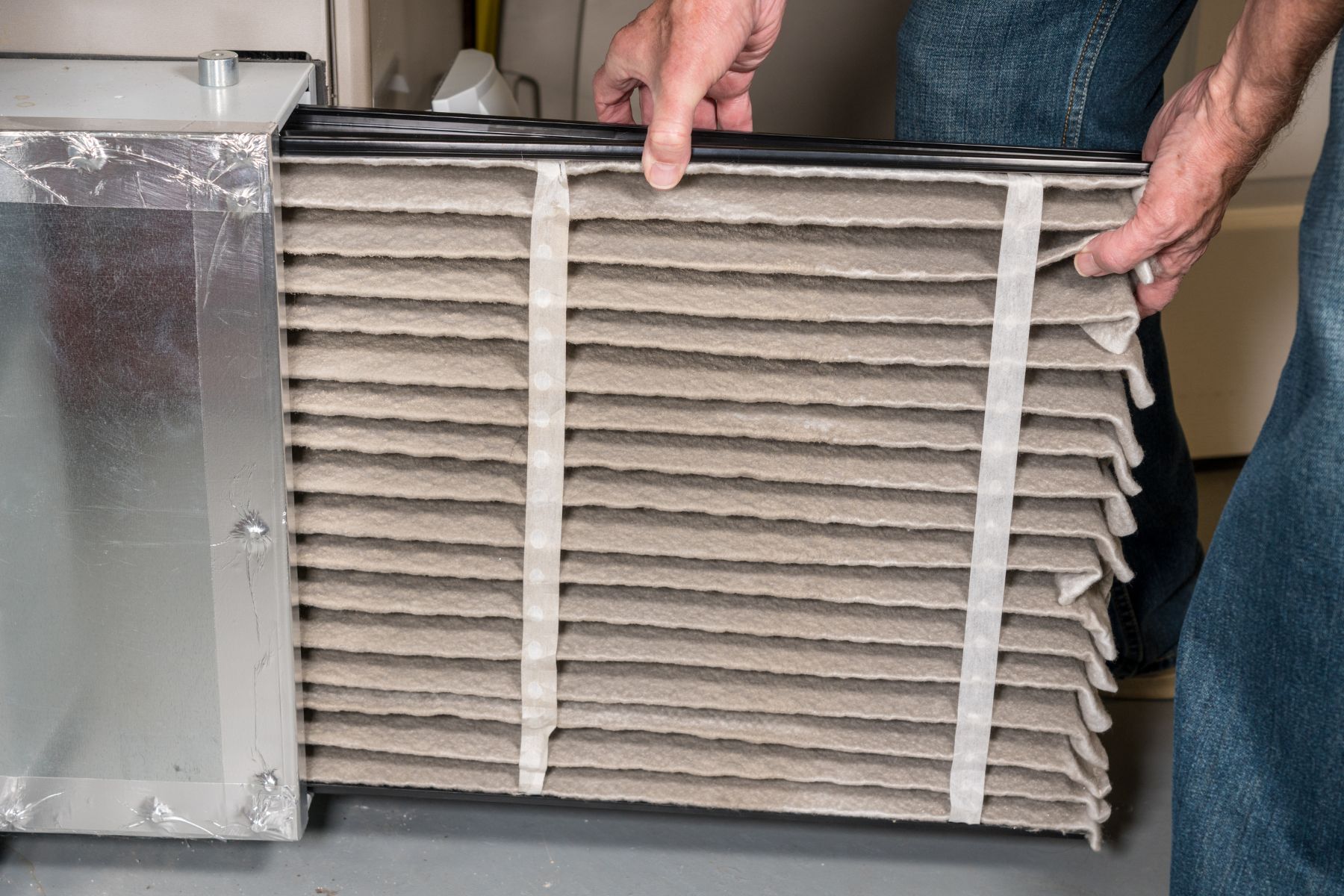
A scorched, dusty smell in the first few minutes after your heat kicks on is almost always dust burning off, and it should fade within an hour. Burning plastic, a sharp fishy or acrid electrical smell, visible smoke, or anything that gets stronger instead of weaker is a different thing entirely. Shut the system off at the thermostat, cut power at the breaker, and call somebody.
That much you will find anywhere. Here is what you will not.
Whether the harmless version is supposed to be happening right now depends on what kind of heat you own. Almost every article on this subject is written about a gas furnace, and a large share of homes around Cullman do not have one. If yours is a heat pump, your normal dust smell runs on a completely different schedule, and the standard advice will have you looking for a problem at the wrong time of year.
The Short Answer
| What it smells like | What it usually is | What to do right now |
|---|---|---|
| Dusty, scorched, like a hot iron | Dust burning off a heat exchanger or electric heat strips | Nothing. Open a window. It should fade inside an hour |
| Burning plastic, or sharp and fishy | Overheating wiring or melting insulation | Off at the thermostat, off at the breaker, call |
| Hot metal, or a sharp ozone smell | A blower motor running hot, or arcing contacts | Shut it down and call |
| Smoke, or you can see haze | Something is actually burning | Get everyone out, then call 911 |
| Sour, musty, like a gym bag | Not a burning smell at all: that one has its own name | Not urgent, but it does not fix itself |
| Chemical, like formaldehyde, on a gas system | Possible heat exchanger failure | Off, windows open, call the same day |
The dividing line worth memorizing: dust smells dusty and gets weaker. Everything dangerous smells sharp and gets stronger.
First, Which System Do You Actually Have?
This takes thirty seconds and it changes the answer to everything below.
Go look at the thing outside. If there is a big metal box with a fan in the top sitting next to your house, and it runs in the winter, you have a heat pump. If that box only ever runs in the summer and goes quiet in October, you have an air conditioner and your heat comes from somewhere else.
Then look at the indoor unit, usually in a closet, attic, garage or crawlspace. A gas furnace has a gas line running to it, a flue pipe going up and out, and a small window or sight glass where you can see a flame. A heat pump's indoor half is an air handler: no gas line, no flue, no flame, just a blower and a bank of electric heating elements. Some homes have both, which is called a dual fuel system; those get the furnace behavior below the changeover temperature and the heat pump behavior above it.
Why this matters: a gas furnace burns dust off a metal heat exchanger that gets extremely hot. A heat pump has no burner and no heat exchanger. Its dusty smell comes from the electric resistance heat strips sitting in the air handler, which are essentially large toasters, and which do not run every time the heat comes on.
This is not an academic distinction. In the climate regions that cover most of the Southeast, heat pumps are the normal way houses are heated. The federal government's residential energy survey found that of the roughly 12.1 million American households using electric heat pumps, about 9.3 million were in the hot-humid and mixed-humid regions, the ones that cover our part of the country. Electricity is now the main heating fuel in 42% of US homes, and in North Alabama that share is far higher than the national figure suggests. The advice written for a Chicago gas furnace was not written for your house.
Why a Heat Pump's Burning Smell Shows Up Later Than Everyone Says
Here is the part that sends people looking in the wrong place.
The standard line is that the smell happens "the first time you turn the heat on for the season." For a gas furnace that is true. The furnace sat untouched all summer, dust settled on the burners and the heat exchanger, and the first heat call cooks it off.
A heat pump does not work that way, and neither does the dust.
Your air handler's blower and indoor coil have been running hard all summer, because in cooling mode they are doing the cooling. They are not dusty from disuse. The only part of that cabinet that has sat completely untouched since last winter is the electric heat strips, and the strips do not fire on an ordinary heat call.
A heat pump heats by moving heat from outside air, and down to a point it does that on its own without any help. That point is the system's balance point, and for most houses around here it lands somewhere between 30°F and 40°F. Above it, the heat pump handles the house by itself and the strips stay cold. The strips only energize when the thermostat calls for backup, when the system runs a defrost cycle, or when you jump the thermostat up several degrees at once. (If you want the full version of how that works and what it costs to run, we wrote it up in auxiliary heat versus emergency heat.)
So put that on a Cullman calendar. You probably nudged the heat on sometime in early or mid October, on a cool morning in the fifties. The heat pump handled it alone. Nothing smelled like anything.
Then the weather turns. The National Weather Service puts Cullman's average first freeze at October 25, and the average first hard freeze at November 6. On that first properly cold night the thermostat finally asks for backup, the strips light up for the first time in eight or nine months, and a winter's worth of settled dust cooks off at once.
Which means a heat-pump homeowner typically gets this smell weeks after turning the heat on, sometimes not until December, if fall stays mild, on a system that has been working perfectly the whole time. And then every article they find tells them first-of-season dust is normal, which does not describe their situation at all, so they keep worrying.
It is normal. It is just normal later.
When the dust smell is normal
- The first properly cold night of the season, on a gas furnace or a heat pump
- The first time backup heat runs, which on a heat pump may be well after you started using the heat
- A brief return of it during a defrost cycle, when the strips fire to cover the gap
- After you raise the thermostat several degrees at once, which forces the strips on
- It fades noticeably within the first hour and does not come back on the next cycle
When it is not
- It smells like plastic, rubber, or something sharp and fishy rather than dusty
- It is getting stronger rather than weaker, or it is still there after an hour
- It comes back every single cycle, days into the cold weather
- You can see smoke or haze, or there are scorch marks anywhere on the unit
- The system shuts itself off partway through a cycle, which usually means a safety limit is tripping
- Anyone in the house is getting a headache or feeling nauseous while it runs
- Your breaker trips when the heat comes on
Smelling something that is not dust? Call us at (256) 915-2826. We will get the panel off, find out what is actually hot, and tell you straight whether it is a part or a problem. Veterans Cooling and Heating is veteran-owned, licensed in Alabama (AL#24210), with 15+ years in the trade, handling heating repair across Cullman County and the surrounding communities.
Ready for honest, dependable HVAC service?
Talk to a real veteran-owned local team. Same-day service available.
What Each Smell Actually Means
Burning plastic, or a sharp fishy odor. This one is wiring. Overheated conductors and melting insulation give off a distinctly chemical, fishy smell that nobody mistakes for dust once they have smelled it. On a heat pump it is often at the strip heater terminals or the sequencer, which carry a lot of current. It does not improve on its own and it is the one that starts fires. Off at the breaker, then call.
Hot metal, or a sharp ozone smell like a photocopier. Usually a blower motor running hot: failing bearings, a seized wheel, or a motor working against restricted airflow. Sometimes arcing contacts in the contactor or relay. Catching this early is the difference between a bearing and a whole motor.
Smoke, or visible haze from the vents. Stop reading and get everyone outside, then call 911 from outside the house. There is no diagnostic worth doing from inside.
Sour and musty rather than burning. That is a different problem with a different cause: mold and bacteria on the indoor coil, which is particularly common on heat pumps in this climate. We wrote about that one separately in dirty sock syndrome. Not an emergency, but it will not resolve on its own.
A chemical smell like formaldehyde, on a gas system. This is the one that warrants same-day attention on a furnace, because it can indicate a cracked or failing heat exchanger. Shut it off, open windows, and get it looked at.
A faint new-appliance smell on a system installed in the last few months. Protective coatings and manufacturing oils burning off. Ventilate and run it; it should be gone within a few cycles.
About Carbon Monoxide, Honestly
Worth being straight about this, because the two get tangled together constantly.
Carbon monoxide has no smell. It is colorless and odorless. You cannot detect it by sniffing, and a burning smell is not a carbon monoxide warning. Anyone who tells you otherwise is confusing two different things.
What is true is that a gas furnace with a combustion problem can produce both a chemical odor and carbon monoxide, from the same underlying fault. The smell is not the detection. It is a reason to have the combustion side checked.
What is also true: a heat pump produces no carbon monoxide at all. No combustion, no CO. If your heat is a straight heat pump with electric backup, the burning smell cannot be a CO issue from the heating system.
That does not mean you can skip the alarm. Most homes around here still have a gas water heater, a gas range, a fireplace or an attached garage, any of which can produce CO regardless of how the house is heated. The Consumer Product Safety Commission's position is straightforward and has not changed in twenty years: a working CO alarm in every home, and a professional inspection of the heating system every year. If anyone in the house is getting headaches, dizziness or nausea that improve when they leave, treat that as the real warning and get out.
What You Can Check Yourself in Ten Minutes
Some of this you can genuinely sort out without calling anyone, and we would rather you tried.
- Smell it properly before you do anything else. Dusty or sharp? Getting weaker or stronger? That one judgment decides everything that follows, and it is the single most useful thing you can tell a technician on the phone.
- Note the time. If it is gone inside an hour, you are almost certainly fine. If you are at ninety minutes and it has not budged, that is your answer.
- Pull the filter and look at it. Hold it up to a light. If light does not pass through easily, replace it. A choked filter makes the blower work hot, and it is a real cause of a burning smell as well as one of the most common things we find on a service call. This costs you a few dollars and two minutes.
- Check your vents and registers. Something sitting on a floor register, a blanket, a box, a toy that found its way in, will cook. So will furniture pushed up against a return.
- Look at the indoor unit. No scorch marks, no melted plastic, no burnt smell concentrated at the cabinet itself. If any of those are there, you are done checking; shut it off.
- Stop jumping the thermostat. Raising it five degrees at once forces the backup strips on and guarantees you get the smell again. One or two degrees at a time lets the heat pump do the work.
What is not a homeowner job: anything behind the blower door, anything involving the heat strips or their wiring, which run on high-voltage circuits, testing a capacitor, checking combustion on a gas furnace, or inspecting a heat exchanger. Those need meters, gauges and a license.
What It Usually Costs to Fix
If the smell turns out to be something, it is most often one of a short list of parts. These are national figures and your job will land where it lands, but they are a reasonable frame for what you are deciding about.
| What it turns out to be | Typical national cost |
|---|---|
| Air filter | A few dollars, and you do it yourself |
| Blower motor capacitor | Part averages around $30, plus labor |
| Blower motor, PSC type | Averages around $575 |
| Blower motor, ECM type | Averages around $875 |
| Labor on a blower motor job | $150 – $250 |
Those blower figures come from This Old House's cost guide. Strip heater and wiring repairs vary too much by system to quote honestly in a table. The amount of work depends entirely on what is scorched and how accessible it is, which is a thing we will tell you after we have the panel off and before we start.
The Cheapest Version of This Is the One You Do in October
Nearly everything on the dangerous side of the list above was visible before it became dangerous. Wiring that is starting to overheat discolors first. A blower bearing makes noise before it smells. Strip heater connections loosen gradually. Dust that is going to burn can simply be cleaned off instead.
That is what a fall heating tune-up is actually for, and why it is worth doing in the four or five weeks before the first freeze rather than after. If you want fewer things reaching the coil in the first place, a better filter is the cheapest indoor air quality improvement there is.
And if you are reading this standing in your hallway tonight with the heat running and something that does not smell like dust: turn it off and call. We would much rather come out and tell you it was nothing.
Veterans Cooling and Heating LLC, veteran-owned, licensed AL#24210, serving Cullman County and the surrounding communities. We handle heat pump and furnace repair across Cullman, Hanceville, Good Hope, Vinemont, Holly Pond, Fairview, Baileyton, West Point, Joppa, and Arab. Call (256) 915-2826, Monday through Friday, 7:00 AM to 6:00 PM.